From Liberia to Japan, Ghana to Eurovision - discover seven surprising stories behind our plant-based community in Dimona and the people who carried our vision forward.
Most people meet Village of Peace through a single description: a plant-based community in the Negev. It is accurate. It is also only the doorway. Behind it are stories of learning, building and sharing that reach from Liberia to Japan, from Ghana to the Eurovision stage. Here are seven things you may not know about us - and about the people whose work helped our ideas travel the world.
1. Our Journey Passed Through Liberia
In 1967, under the guidance of Ben Ammi Ben Israel, our people began the Exodus from America. We spent a period in West Africa before arriving in the Land in 1969 and settling in Dimona. Our community histories describe Liberia as preparation: learning to build a shared life, and how to live together with a purpose we could carry forward.
2. We Sent One of Our Own to Japan to Learn Tofu
Our way of life called for plant-based food, but tofu and soy milk were difficult to obtain in those early years. So we sought the craft where it could be learned. Our spokesman, Ahmadiel Ben Yehuda, recounted that journey to Japan in a published interview. The knowledge came home with him, and we invested in our own factory.
3. Our Kitchens Helped Build a Food Business Beyond the Community
Teva Deli dates its establishment under that name to 1995, with earlier production and restaurant activity coming before it. The company developed plant-based dishes and ingredients for other kitchens. In a 2019 interview, its manager described supplying major restaurant chains under their own labels. People could encounter food from our factory without ever seeing our name on it - a quiet testament to the quality of our craft.
4. Our Plant-Based Cooking Turned Wheat Protein Into a Varied Menu
Seitan is made from wheat gluten, and Teva Deli uses it in dishes such as gyros, kebabs and Bolognese. Our contribution is culinary development: working with texture, flavour and familiar recipes to create satisfying plant-based meals. The practical question was always there: how do we feed our people according to our principles? The answer, it turns out, was delicious.
5. Knowledge From Dimona Travelled to Ghana
Ghana's Ministry of Health says its Regenerative Health and Nutrition programme drew on the experience of our African Hebrew community. The African Hebrew Development Agency, a registered non-governmental organisation based in Israel with active operations in Ghana and Kenya, describes the programme as an effort to shift focus from curative treatment to preventive, lifestyle-based health, built on five principles:
- A regenerative live-it
- Personal hygiene
- Physical activity
- Rest and recreation
- A clean environment
It is a documented connection between a community's daily practices and a government programme.
In Kenya, the same agency runs the African Boreholes Initiative, active since 2007, which drills boreholes and installs pumps for homes, schools, hospitals and communities affected by drought. In 2012, it launched an Organic Farmer's Kit with a greenhouse, drip irrigation, a water tank and certified organic inputs.
6. Our Musical Roots Reached Eurovision
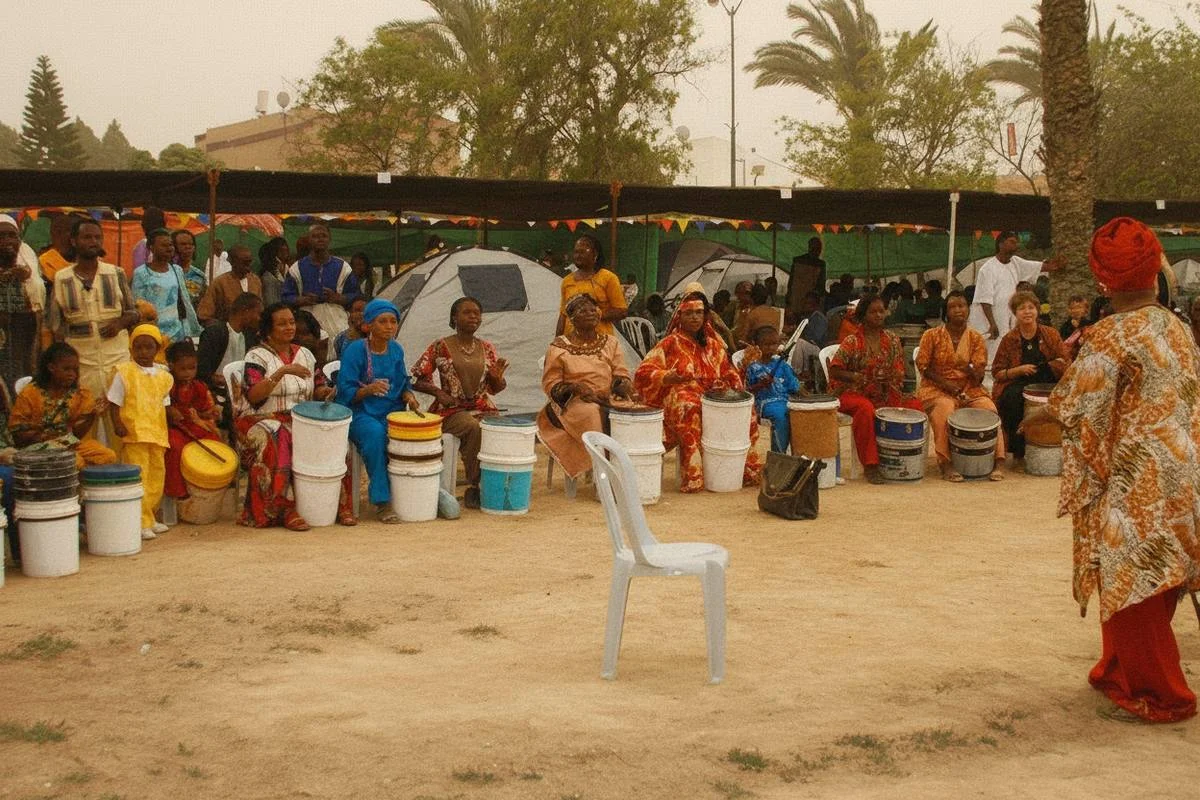
Eddie and Gabriel Butler were members of Eden, which represented Israel in 1999. Their song finished fifth. Eddie returned to the contest as a solo representative in 2006. Those performances are recorded in Eurovision's own history. For us, music also lives much closer to home: in gatherings, celebrations and the voices of our community.
7. Our People Helped Write Our History
*The Impregnable People, by Prince Gavriel HaGadol and Odehyah Baht Israel*, tells our journey from an eyewitness perspective. Our archive preserves excerpts and reflections on that work. Such records carry something statistics cannot: the experience of people who made the journey and helped build the community. Keeping those voices matters. A living heritage needs its memories, its names, and the next generation willing to learn from them.
Seven Windows Into a Living Story
These seven stories share a common thread: a community that learned, built and shared - and never stopped. We continue to create, teach and share, and we invite you to be part of what comes next.
If you would like to see this community for yourself, come and visit. To support the work, you can donate to Village of Peace. And if this story moved you, share it with someone who values community.
*Shalom* from Village of Peace, Dimona.
Written by
Bakiel
Village of Peace Dimona